
Salt guide
for responsible salt use that reduces chloride pollution into our water.
Kids Creek.
Grand Traverse Bay Watershed.
Chloride from salt use is contributing to the water quality impairment of Kids Creek. Understanding when and how chloride enters the creek will help guide solutions that protect Kids Creek while still keeping us safe in winter.
Why Kids Creek Matters
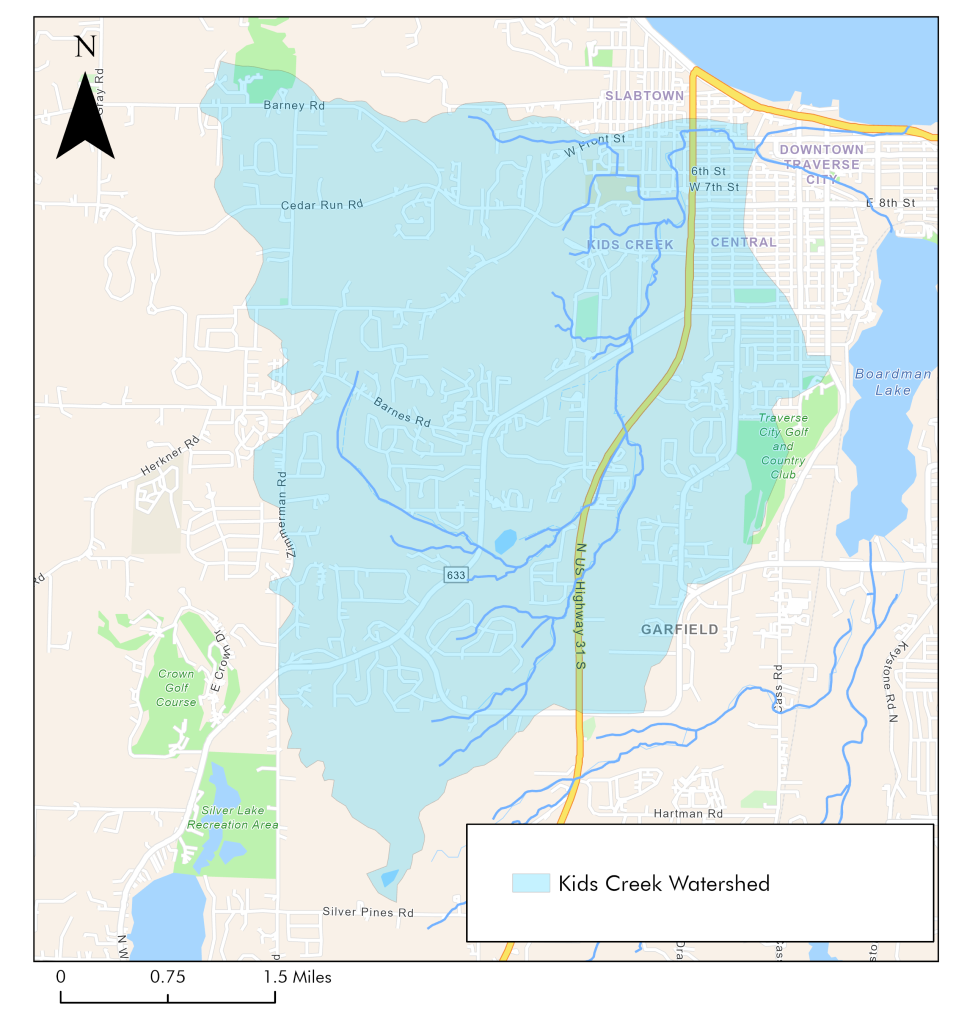
Kids Creek, a cherished cold-water trout stream on Traverse City’s west side, is considered impaired because of its poor aquatic insect community. Resource managers are increasingly concerned that elevated chloride levels from deicing products are contributing to the water quality impairment in Kids Creek and placing additional stress on aquatic life. Because Kids Creek runs through developed areas, it is especially vulnerable to salt runoff from impervious surfaces in wintertime.
Click the link below to learn more about Kids Creek and what The Watershed Center is doing to restore this urban gem.
Our Monitoring and Findings
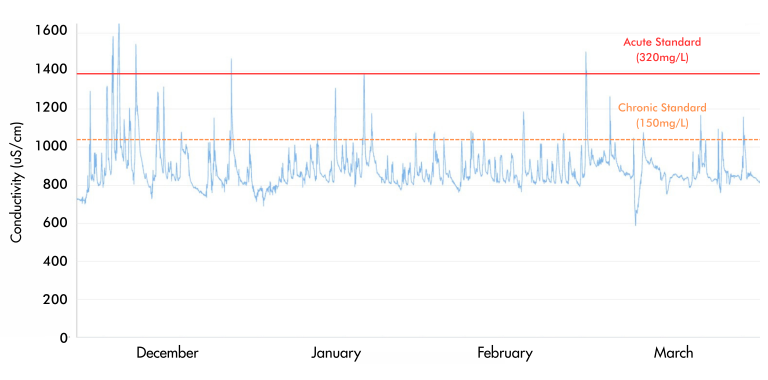
Conductivity measured in Kids Creek at Third Street from December 2024 through March 2025. Data gathered from monitormywatershed.org.
In 2020, The Watershed Center partnered with Trout Unlimited to continuously monitor water level, conductivity, and temperature at two locations in Kids Creek. Using EnvrioDIY Mayfly automated monitoring stations, this data is collected every 15 minutes and uploaded in real time to the Monitor My Watershed website.
In freshwater systems, conductivity provides a reliable estimate of chloride concentration, allowing scientists to easily track changes in chloride concentrations throughout the year and during specific events such as rainstorms and snowmelt.
Data show that chloride concentrations fluctuate in Kids Creek throughout the year, with the highest concentrations often occurring during winter and early spring rain and snowmelt events.
When conductivity exceeds 1,000 µS/cm (orange line on the graph to the left), chloride concentrations are high enough to cause stress to sensitive aquatic organisms. This level exceeds the State of Michigan’s chronic chloride standard meaning prolonged exposure can affect behavior, growth, and reproduction.
When conductivity exceeds 1,300uS/cm (red line on the graph to the right), chloride concentrations may be lethal to some aquatic organisms. This level exceeds the State of Michigan’s acute chloride standard meaning that even short-term exposure can impair mobility and survival.
State Monitoring and Findings
In 2022, the Michigan Department of Environment, Great Lakes and Energy (EGLE) launched a two-year water quality study in the Kids Creek watershed to better understand chloride impacts and to refine the relationship between conductivity and chloride concentrations in the creek. EGLE’s monitoring focused on how rainfall, snowfall, and snowmelt events affect chloride levels in Kids Creek. The study included rain and snowfall event-based sampling during winter months, as well as routine monthly monitoring at five locations throughout the watershed.
Results showed that nearly 10% of samples exceeded the state’s chronic chloride standards. Several samples collected during snowmelt events approached nearly double the state’s acute exposure limit, signaling that Kids Creek experiences short-term pulses of chloride that are toxic to aquatic life.
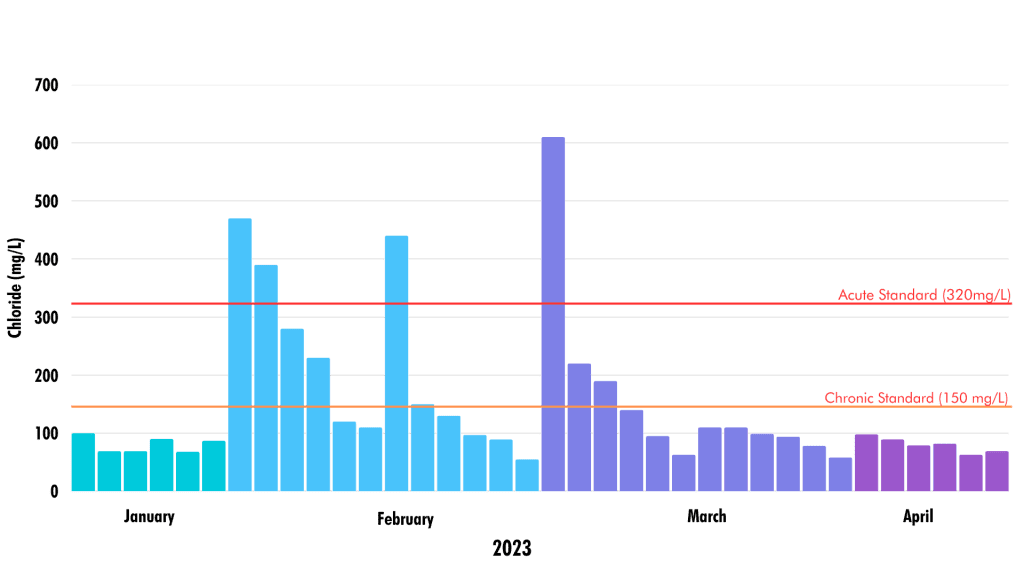
Chloride measured in Kids Creek at various locations by EGLE from January through April 2023.
Why This Matters
These findings confirm that Kids Creek, a stream that is fed primarily by groundwater, has slightly elevated chloride concentrations year-round due to contaminated groundwater. In winter months, extremely high concentrations of chloride pulse through the system during and after snowmelt events as chloride is washed off pavement and released from snowbanks. These short-lived pulses of high chloride are impacting aquatic life in the creek.
Understanding when and how chloride enters Kids Creek helps guide solutions that protect the creek while still maintaining public safety during winter.

This project has been funded wholly through the Michigan Department of Envrionment, Great Lakes and Energy’s Nonpoint Source program.